
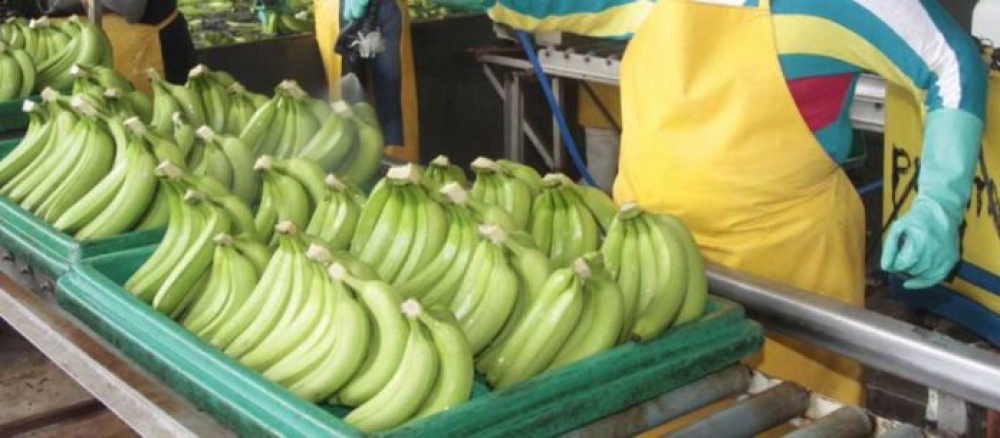
Banana cultivation requires special soil and climatological characteristics, among which the following should be mentioned:
Banana Ecology
The climatic conditions for banana production are located between coordinates of 30 degrees north and 30 degrees south of the equator, but in optimal conditions it occurs between 0 degrees and 15 degrees and an altitude of 0 to 300 meters above sea level. with an average temperature of 27 degrees centigrade.
Precipitation: The water requirements in the banana plant are high due to its herbaceous nature and the fact that 85-88% of the weight of the banana is water.
It is recommended to plant banana in those areas that have precipitation levels that oscillate between 2,000 and 3,000 mm distributed equally throughout the year.
Solar brightness: It is essential for the photosynthetic activity of the plant, the sprouting and growth of new children.
Soils: Banana cultivation is planted in a wide range of soils.
In the banana production process, certain conditions are required at the level of planting, maintenance work, harvest work and processing work, about which we write below.
Sowing
Land preparation:
- When it is a field in stubble, we proceed to eliminate the weeds.
- When it is a paddock, it is recommended to overgraze.
- After the above, we proceed to:
- Plow to a depth between 25 and 30 cms.
- Rake after fifteen days.
- Level with a harrow.
- Raise topographical plans of the land.
Construction of the drainage network
Drainage is practiced mainly in regions with a humid climate, that is, where annual rainfall exceeds annual transpiration and where conditions
natural, create an excess of water on and in the soil. Drainage is the technique by which the water that saturates the soil is quickly eliminated to a depth of 1.5 meters, that is, the depth that the banana plant needs to develop an abundant and deep root system.
Irrigation:
Technique that consists of artificially applying water to a crop. The quantity and frequency of the application depends on the water requirements of the plantations, the type of soil, the quality of the water, and the rainfall and evapotranspiration regimes.
Seed, tracing, drilling, sowing Seed:
The clone to be planted is selected, either Válery or Gran enano. Asexual type vegetative seed is traditionally obtained from established plantations. There are several types of seed: corm, bull’s head and puyón.
Another means of obtaining seed is through banana meristems from the laboratory.
Planting density and plotting:
The density with which you want to sow is determined, which is traditionally called a Triangle System with distances of 2.5 m between plants for a total of 1,853 bushes/ha.
Once the density is determined, each site to be planted is traced or aligned in the field with a stake.
hollowed out:
In each demarcated site, a hole of 50 X 50 X 50 cm is generally made
depending on the type and size of the seed. Fertilizers can be applied there.
organic matter, and the necessary amendments.
Sowing:
Once the hole is made, the seed is placed, it is covered with soil, compacting it well in order not to leave empty spaces. Likewise, a small embankment should be made to prevent waterlogging in the planted sites.
Disease Control:
The two banana-producing areas for export have the Black Sigatoka disease caused by the fungus Mycosphaerella fijiensis as the greatest limitation.
Until now, the main and almost only control is chemical and contact and systemic fungicides are used. The control of this disease represents a high percentage of production costs.
Fertilization:
It is one of the most important activities in banana cultivation to obtain good yields.
To establish a fertilization program it is necessary to carry out a soil and foliar analysis every year.
Banana programs should be focused on carrying out monthly cycles of fertilization and incorporation of fertilizers into the soil. The main elements extracted by the banana plant are Potassium and Nitrogen, without being less important Phosphorus, Calcium, Magnesium, Sulfur, Iron, Copper, Manganese and Zinc.
The recommended doses and required elements are:
Demache or desuckering:
The banana plant genetically has the ability to produce several children or suckers that are distributed around the mother plant.
In banana cultivation, an adequate population (number of production units) must be managed, in accordance with the type of soil, clone used, vigor and leafiness of the plant.
To do this, demache or desuckering is carried out, which is simply to leave each plantation with its son and grandson, that is, a complete production unit to guarantee that the number and size of bunches per hectare is optimal and that the plantation is maintained as a perennial crop.
It is a very important practice and good yields largely depend on it.
The frequency of this work is between 6 and 8 weeks.
Pocket:
It consists of protecting the bunch with a polyethylene plastic bag or cover from the attack of pests and the abrasive effects caused by leaves or chemical products.
and also protect it from sudden changes in temperature.
Two cycles should be performed per week.
Fruit Age Identification:
It is to allow knowing the age and number of clusters present in each lot of the farm. This task is carried out at the time of bagging and consists of using a
ribbon of the color corresponding to the week and tie it to the bunch.
In some marketers, the pre-marked bag or spray paint is used
to identify the clusters which allows to take an inventory of the fruit.
Hand pruning or weeding and weeding:
It consists of eliminating the false hand and small hands from the bunch, as well as the bacota, with the aim of contributing to increasing the length, thickness and weight of the fingers of the remaining hands and also to the health of the bunch.
This work is carried out twice a week together with the work of the bag.
Mooring:
It consists of tying two ropes called “winds” from each bush that has a cluster, with the aim of preventing the plant from falling due to the action of the wind, the weight of the cluster or the attack of nematodes.
It is done weekly.
Deviation of the puyón or son:
It is to separate the son from the mother plant to avoid damage to the fruit by the rubbing of its leaves. This task should be done weekly.
Cluster Deviation:
This task is preferably carried out when the bunch is between 4 and 6 weeks old and or when circumstances require it.
Leaf removal:
It consists of eliminating dry, old, broken leaves that can cause deterioration in the quality of the bunch, or be a source of propagation of diseases and pests. One or two weekly cycles are carried out, depending on weather conditions.
Harvest work
Puja or harvest:
This task is simply to go through the plantation cutting all the clusters that meet the calibration and age conditions stipulated by the marketer.
The harvest is done weekly and lasts two or three days.
Colear:
It consists of receiving in a padded cradle that is on the operator’s shoulder, the bunch that the puyero cuts to carefully take it to the cable track.
Drink:
It is to receive the bunch that the colero brings and hang it on the pulley that is on the cableway.
Garrucha:
It is to transport the harvested bunches through the cableway from the lots to the packing houses.
Benefit Labors
Barcadillo:
This work is done in the place called barcadilla, which is located at the entrance of the packing house and where the operator inspects the quality of the bunches to select the suitable hands according to the specifications of the shipment.
Dishand:
It is the first task in the benefit and consists of separating the hands from the bunch using the tool called desmanera and depositing the selected hands in the Desmane tank.
Gurbia:
It consists of dividing the hands into smaller segments or “cluster” according to the quality specifications. The tool used is the Gurbia.
The selected clusters are passed to the next tank (demilking tank), where the fruit undergoes a sealing process and no more latex is emitted.
Fruit weighing:
The clusters remain more or less fifteen minutes in the demilking tank and are then selected and weighed in plastic trays. A minimum net fruit weight of 19.1 kilos must go, since, in the dehydration process during transport, the fruit loses weight and the buyer must be given a net fruit weight of 18.14 kilos per box.
Fruit disinfection:
It is to apply a fungicide or disinfectant solution in such a way as to guarantee coverage of the crowns and not allow the clusters to suffer from post-harvest diseases.
Box packing:
This task is preceded by the sealing of the fruit and the assembly and gluing of the box itself.
Once the bananas are packed, the boxes are covered.
Palletized:
It is grouping the boxes on a pallet in such a way as to facilitate transport, loading and unloading, maintaining the quality of the fruit. These palettes consist of
48 boxes in total, distributed in eight vertical lines.